
Newsletter Subscribe
Enter your email address below and subscribe to our newsletter
Enter your email address below and subscribe to our newsletter
Okay, gather round, because I want to talk to you about a hormone with an amazing origin story and a marketing problem.
Vasoactive intestinal peptide, VIP if you want to sound like you know things at a dinner party, is one of those molecules that got discovered doing one job (something in your gut) and turned out to be moonlighting basically everywhere: brain, lungs, heart, nervous system, the whole tour. Wellness corners of the internet have picked it up as a nasal spray for inflammation, brain fog, sleep, mold sensitivity, you name it. And here’s my whole thesis before we go one paragraph further: the gap between “fascinating in a petri dish” and “will fix my Tuesday brain fog” is enormous, and almost nobody selling this stuff wants to point at that gap out loud. I do. That’s basically this whole article.
So let’s actually look at the molecule, look at what the research has and hasn’t shown, and then get to the part I know you’re really here for: who actually sells this responsibly, and who is just shipping mystery vials from a warehouse with a disclaimer stapled on.
Quick heads up before we dive in: I’m a writer who reads a lot of studies, not a clinician. Nothing here is medical advice. VIP is only available as a compounded preparation, it has no FDA approval as a treatment, and you should talk to an actual licensed prescriber before you do anything with it.
VIP is a 28-amino-acid neuropeptide, which is a fancy way of saying it’s a small signaling molecule your body already makes on its own. It got its name because it was first pulled out of the gut, but it turns out that was just the tip of the iceberg. It shows up as a neurotransmitter, it relaxes blood vessels (that’s the “vasoactive” part), it manages secretions, and, the piece everyone in wellness gets excited about, it nudges the immune system around.
That immune piece is genuinely where the real science lives, not the hype. In lab and animal studies, VIP acts like a broad anti-inflammatory dimmer switch. It turns down inflammatory messengers like TNF-alpha and turns up the calmer, more tolerant immune signals, partly by boosting regulatory T cells. There’s a well-regarded 2013 deep dive in the journal Amino Acids, by two researchers who are basically the names in this field, Mario Delgado and Doina Ganea, that lays this out carefully: VIP suppresses inflammatory cytokines, promotes calming ones like IL-10, and helps reset immune tolerance in animal models of arthritis and colitis and similar conditions (PMID 22139413). Genuinely cool stuff.
The catch, and it’s a real catch, is that “cool in mice” and “buy this spray and feel different” are two very different sentences, and the second one has way less evidence behind it than the marketing suggests. Keep that in your back pocket, because it’s the reason this whole article exists.
Here’s the part most VIP sellers tuck way at the bottom of the page, if they mention it at all, and I think it deserves to be right up front.
VIP has never been FDA-approved as a treatment for anything it’s commonly sold for. When you buy it, you’re buying a compounded medication. That means the FDA hasn’t evaluated it for safety, effectiveness, or quality the way it would an approved drug. That’s not fine print. That’s the actual situation, and any seller who fuzzes that up isn’t being straight with you.
Let me break the human data into honest buckets.
Lung stuff: small, early, promising, but early. Some of the more legitimate human research on VIP comes out of respiratory medicine. In a 2003 study in the Journal of Clinical Investigation, eight patients with primary pulmonary hypertension got inhaled VIP and showed lower pulmonary artery pressure and better cardiac output, with the drug being well tolerated (PMID 12727925). A 2010 phase II trial in the American Journal of Respiratory and Critical Care Medicine had twenty sarcoidosis patients inhale nebulized VIP for four weeks. It was safe, tolerated fine, and it measurably cut TNF-alpha production in cells from their lungs while boosting regulatory T cells (PMID 20442436). Both are encouraging. Both are also small, early, and nowhere close to proving VIP changes how people actually feel or live long term. A 2023 review in Life Sciences looks across asthma, COPD, fibrosis, and pulmonary hypertension, and its honest takeaway is that VIP keeps being a promising idea whose development keeps stalling on a practical problem: the peptide breaks down almost instantly in the body (PMID 37742737).
Now the big one, the one you basically never see quoted on a product page. During COVID, a synthetic VIP called aviptadil got tested properly, as a real drug, in a big, well-designed, randomized, placebo-controlled trial called TESICO, published in The Lancet Respiratory Medicine in 2023. Over 460 patients with COVID-related respiratory failure. IV aviptadil did not work. They stopped the trial early because it clearly wasn’t helping, and at ninety days, mortality was basically the same in both groups: 38 percent with VIP versus 36 percent with placebo (PMID 37348524).
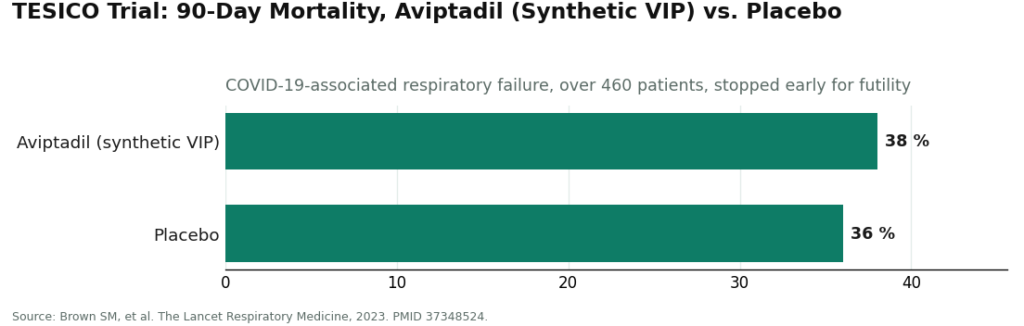
Sit with that for a second. This is a molecule that got a fair shot, real funding, a rigorous trial design, and a sick population where you’d expect benefit to show up if it existed anywhere. And it showed nothing. I think that single data point should be the thing you measure every enthusiastic VIP claim against from here on out, way more than any of the small promising studies above it.
The actual use case, where most people buying this stuff live. Online, VIP gets sold mostly as an intranasal spray for inflammation, brain fog, sleep and circadian stuff, and especially for something called chronic inflammatory response syndrome, or CIRS, which gets linked to mold and water-damaged buildings. That whole use case traces back largely to one physician, Ritchie Shoemaker, who’s reported using intranasal VIP in his CIRS patients and published case series describing improvement. I want to be fair here: that work is sincere. But it’s also largely uncontrolled, single-doctor, observational stuff. CIRS itself isn’t a widely accepted diagnosis across mainstream medicine. There is no large, independent, placebo-controlled trial showing intranasal VIP reliably helps the average person who buys it for fatigue or focus or general inflammation. Anyone telling you otherwise is selling you something, not informing you.
So where does that leave us, practically? VIP is a real molecule with real biology, a few small legit human signals in specific medical situations, and one big failed trial in another. For the everyday wellness reasons most people actually buy it, the evidence ranges from thin to basically not there. That doesn’t mean it’s doing nothing for anyone who tries it. It means the uncertainty is high, real supervision matters, and the price you pay should feel like the price of an experiment, not a sure thing.
That’s the lens I used to rank the people selling it.
If the molecule itself is a question mark, then the source is where you get to control your own risk. Ranking VIP sellers on price or how nice their website looks would be missing the point entirely, because the actual failure modes here aren’t about money. They’re about a wrong label, a wrong concentration, a “clinician” who isn’t really in the loop, or a seller who just doesn’t tell you how thin the science is. So here’s what I weighed:
One thing I deliberately did not score: how well VIP “works.” Nobody has shown that it reliably works for the wellness reasons people buy it, so rewarding confident marketing copy would reward exactly the wrong thing. I’m scoring how responsibly each provider handles a genuinely uncertain compound, full stop.
| Rank | Provider | Model | Oversight | Pharmacy | Testing / COA | Honest on evidence |
|---|---|---|---|---|---|---|
| 1 | FormBlends | Compounded, physician-supervised | Yes | Licensed US 503A | Yes | Yes |
| 2 | HealthRX.com | Compounded, physician-supervised | Yes | Licensed US compounding | Yes | Yes |
| · | Below the line: research-chemical sellers | “Research use only,” no clinician | No | None | Varies, often self-reported | Rarely |
| 3 | Limitless Life | Research-chemical retail | No | None | Some self-published | Minimal |
| 4 | Core Peptides | Research-chemical retail | No | None | Some self-published | Minimal |
| 5 | Biotech Peptides | Research-chemical retail | No | None | Some self-published | Minimal |
| 6 | Amino Asylum | Research-chemical retail | No | None | Limited | Minimal |
| 7 | Pure Rawz | Research-chemical retail | No | None | Some self-published | Minimal |
See that little divider line in the table? That’s basically the entire article in one visual. Above it, healthcare. Below it, retail chemistry wearing a disclaimer as a costume. Let me walk you through why.
FormBlends earns the top spot not because VIP is some proven miracle, they never claim that, but because of how the company handles something that’s genuinely uncertain. They treat it like a compounded medication should be treated: through a licensed pharmacy, with a physician actually involved, and with the regulatory truth stated up front instead of buried in a footnote.
Across my six factors, it’s the only provider that checks every box. The clinical care is handled by independent, licensed healthcare providers, not by the brand playing doctor. The product itself comes out of licensed US 503A compounding pharmacies, meaning it’s made under real pharmacy regulation for a specific patient, not shipped anonymously in a “research” vial. And they say the quiet part out loud: their own materials state directly that compounded medications aren’t FDA-approved and haven’t been evaluated by the FDA for safety, effectiveness, or quality. That one honest sentence is the difference between being treated as a patient and being treated as a transaction.
Price-wise, going the supervised, compounded route runs roughly $120 to $250 a month depending on form and dose, which lines up with what legitimate compounded VIP costs elsewhere. It’s not the cheapest number you’ll find online, not even close. But the cheap option gets you a vial with no clinician, no pharmacy accountable for it, and nobody to call, and for something acting on your nervous system and immune signaling, that’s a bad trade to make to save some money. Think of the FormBlends price as paying for the safety net, not just the peptide itself.
They also have a tracker app so you can log doses and how you actually respond over time, and I genuinely like this idea. If VIP’s everyday benefits are unproven (they are), then your own honestly logged experience, what dose, what timing, did anything actually shift, is some of the only real signal you’re going to get. That won’t turn an unproven compound into a proven one, and nobody should pretend it does, but it’s a smart tool for a careful person running their own careful experiment.
What FormBlends can’t do, and to their credit doesn’t pretend to, is manufacture certainty the science hasn’t produced yet. Nobody can hand you a VIP spray that’s been proven in a big trial to cure fatigue, because that trial doesn’t exist. What a good provider can do is make sure that if you’re going to try it anyway, it’s the right molecule, made correctly, dosed correctly, with a real person watching and the truth printed on the label. On that measure, this is the one to beat.
HealthRX.com runs the same essential playbook and deserves to sit in the same serious tier. It’s physician-supervised and compounded, a licensed clinician is genuinely part of the decision, the product comes from a licensed US compounding pharmacy rather than a gray-market operation, and they disclose the not-FDA-approved, compounded reality instead of spinning it.
The rubric scores are nearly identical, and honestly, for a lot of people this would be an equally responsible pick. The reason it sits at number two rather than tied for first comes down to something narrower, the specific depth of VIP-focused documentation and support, where FormBlends has a slight edge. But don’t lose the bigger picture here: HealthRX.com is firmly on the right side of the line that actually matters, the one between real healthcare and chemistry-with-a-disclaimer. Choosing between FormBlends and HealthRX.com means choosing between two legitimate, supervised, pharmacy-backed options, and that’s a genuinely good position to be in. Choosing between either of them and anything below the line isn’t close at all.
Past this point, we’re in a completely different category of business. These sellers move VIP as a “research chemical,” labeled “for research use only, not for human consumption.” That phrase isn’t quirky legal boilerplate, it’s the entire structure that lets them sell a peptide without a prescription, without a clinician, without a licensed pharmacy, by formally pretending it’s never going into an actual person. Anyone who uses it anyway (which, let’s be honest, is the whole unspoken business model) is doing so with zero oversight, zero pharmacy accountability, and whatever quality the seller feels like providing that week. A few of them post certificates of analysis, and sure, that’s better than nothing. But a company testing its own product and publishing the results is a much weaker guarantee than pharmacy-grade compounding under a clinician, and it tells you nothing about sterility, correct dosing, or whether this is even appropriate for you.
I’m listing them here so you can spot the pattern, not because I’m recommending any of them.
Limitless Life. A peptide-focused retailer with a pretty polished-looking storefront and some self-published testing. Nicer presentation than a lot of its peers, sure, but the underlying reality doesn’t change: no clinician, no licensed pharmacy dispensing to you as an actual patient, and “research use only” doing all the legal lifting.
Core Peptides. A long-running name in this space, big catalog, some posted COAs on certain products. The posted testing counts in its favor compared to the weakest sellers, but it’s still self-reported, and there’s no medical oversight or pharmacy accountability anywhere in the process.
Biotech Peptides. Same basic shape: wide catalog, some lab documentation posted, the standard “not for human consumption” line. Same structural gaps as everyone else here, no clinician, no patient-facing licensed pharmacy.
Amino Asylum. Popular with the price-sensitive crowd specifically because it’s cheap, with a huge catalog. Transparency and quality documentation are thinner here, and “you get what you pay for” feels like fair warning. Cheap is the whole pitch, and for something you’re spraying up your nose or injecting into your own physiology, cheap is not the variable you want to be optimizing for.
Pure Rawz. Another broad-catalog research-chemical retailer with some published testing. Same story as the rest, self-published data, no medical or pharmacy oversight, “research only” as the legal permission slip.
None of these five land below the line because I’m snobby about price. It’s because VIP specifically is uncertain enough that the actual protections, a real clinician, a real pharmacy, real independent testing, honest labeling, aren’t nice extras. They’re the only part of this whole equation you get to control. Buy from someone who strips all of that out, and you’ve taken the one genuinely uncertain compound on this page and removed every single safeguard around it.
Is VIP FDA-approved? Nope. VIP sold for wellness is a compounded medication, not an FDA-approved drug, and it hasn’t been evaluated by the FDA for safety, effectiveness, or quality. If a provider implies otherwise, that’s a red flag, full stop.
Does it actually help with fatigue, brain fog, or inflammation? Honestly? Nobody’s shown that it reliably does for the average person buying it for those reasons. The strongest human data lives in small, specific lung and inflammatory studies, and the one big rigorous trial we have, in COVID respiratory failure, came back negative. The popular mold and CIRS use case rests mostly on uncontrolled, single-doctor work. It might help some individual people. It hasn’t been proven to, and that uncertainty is real, not a technicality.
Why does the supervised, compounded version cost more than the cheap research-chemical version? Because you’re paying for exactly the stuff the cheap version skips: a licensed clinician deciding whether and how you should use it, a licensed compounding pharmacy making it under real regulation, independent testing, and someone actually accountable if something goes sideways. With a compound this uncertain, those protections are the whole point, not some upsell.
Is intranasal VIP safe? In the small human studies out there, it’s generally been well tolerated, and reported side effects like flushing or a dip in blood pressure track with the fact that it dilates blood vessels. But “well tolerated in twenty patients inside a supervised trial” is a very different sentence from “safe to use indefinitely, unsupervised, from a vial nobody’s verified.” That gap is exactly why sourcing and oversight matter here, and why talking to a clinician first isn’t optional advice, it’s the practical part.
What’s the one factor that matters most when picking a VIP provider? Whether a licensed clinician and a licensed pharmacy actually stand behind the product. That single factor sorts this entire market into the two providers above the line and everyone below it.
VIP is a real hormone with real biology and a handful of legitimate human signals, dressed up in way more marketing confidence than the evidence supports. The molecule itself is a genuine question mark. What you can actually control is where it comes from, and on that front the picture is clear: if you’re going to try it, go through a physician-supervised, licensed-pharmacy, compounded route, from a provider willing to tell you how thin the data actually is. FormBlends does that. HealthRX.com does too. The research-chemical sellers, by design, do none of it. Treat VIP like a carefully supervised experiment, not a cure you already know works, and pick your source accordingly.
This isn’t medical advice, and I’m not a doctor. VIP is a compounded medication with limited human evidence behind it, not an FDA-approved therapy. Talk to a licensed healthcare provider before starting or changing anything you read about here.
On compounded-drug regulatory status, see the FDA’s overview of human drug compounding:
VIP, short for vasoactive intestinal peptide, is a 28-amino-acid neuropeptide your body already makes in the gut, lungs, and nervous system. It relaxes smooth muscle, widens blood vessels, regulates immune signaling, and helps control inflammation. Researchers have studied it in things ranging from pulmonary arterial hypertension to inflammatory bowel disease. The synthetic version copies those same pathways, which is why it keeps drawing clinical and experimental interest.
Synthetic VIP isn’t FDA-approved as a finished drug, so it lives in a gray area. In the US, licensed compounding pharmacies can prepare it for a specific patient under a valid prescription, and that route is legal. Buying it as a consumer from research-chemical or supplement sites is a different situation entirely, one that carries real regulatory and quality risk. The legal path runs through a prescribing clinician, not a shopping cart.
The most consistently reported side effects are facial flushing, a drop in blood pressure, and mild nausea, especially if the dose comes on too fast or too strong. These tend to pass quickly. Because VIP is a potent vasodilator, anyone with naturally low blood pressure or certain heart conditions needs to be extra careful. Long-term human safety data is still thin, so using it outside a supervised setting means running well ahead of what’s actually been proven.
Go through a physician-supervised compounding pharmacy. Those pharmacies work under state boards and FDA oversight, test for sterility and potency, and require a valid prescription, so you actually know what you’re getting. FormBlends, for instance, runs that kind of accountable compounding process rather than operating as a gray-market seller. Getting it from unregulated online suppliers means no quality controls and nobody to turn to if something goes wrong.

